Alcohol vs Water-Based Markers: Pick by Behavior
Pick the ink family by the job
Alcohol- and water-based markers differ mainly in their carrier system, drying behavior, paper interaction, layering, odor, and cleanup requirements. Neither family is automatically “professional,” permanent, safe for every surface, or superior at every task. Choose by the marks you need, then verify the exact product label; a family resemblance is not a technical specification.
The supply basics section starts with behavior rather than price or cap color.
Alcohol-based markers favor fast, layered fills
Many illustration markers use dye carried in an alcohol-based solvent system. On suitable paper, adjacent strokes can merge while wet, and repeated passes usually deepen transparent color. Fast evaporation can support quick layering, but it also means a wet edge can disappear mid-fill.
Alcohol ink commonly bleeds through ordinary paper and may feather on absorbent fibers. Use clean backing sheets and test the exact paper. Markers can have a noticeable odor and require the ventilation, handling, storage, and fire precautions on their labels. “Art supply” is a job description, not an exemption from chemistry.
These markers are often chosen for smooth illustration, rendering, and controlled gradients. Results still depend on nib width, ink flow, paper coating, hand speed, and the specific color. Pale and dark dyes may not blend identically.
Water-based markers span a wide range
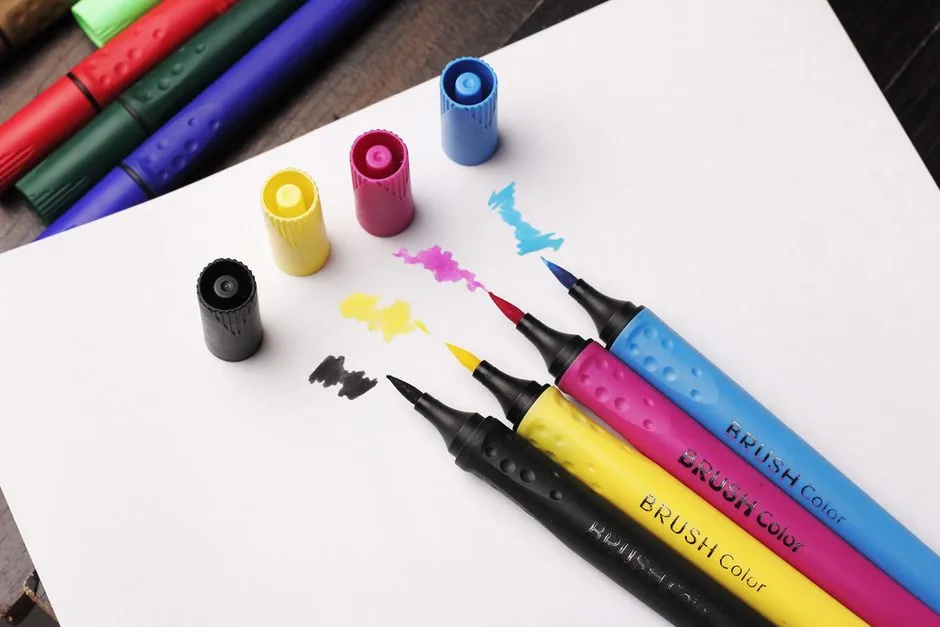
Water-based markers include many washable, school, brush-lettering, pigment, dye, and paint-style products. The phrase describes a broad carrier family, not one performance profile. Some are transparent and reactivatable; others become water-resistant when dry; some sit more opaquely on the surface. Read the maker's description before assuming.
On paper, water can swell fibers, cause pilling under repeated scrubbing, or warp a light sheet. It may also allow washes, soft edges, and techniques that resemble watercolor when the product is designed for them. Use watercolor or mixed-media paper when the method adds substantial water and the manufacturer supports that use.
Washable does not mean stain-proof on every fabric or surface. Follow label directions and test cleanup somewhere inconspicuous.
Compare them on five practical questions
1. What edge do you need?
Alcohol markers can create smooth wet-into-wet transitions on compatible paper. Water-based ink may produce crisp shapes, brush texture, or reactivated edges depending on formula and moisture.
2. How much layering will the paper tolerate?
Alcohol ink can saturate and bleed through. Water and repeated brushing can roughen fibers. In both cases, paper is part of the tool, not passive scenery.
3. What surface are you marking?
Paper, plastic, glass, fabric, and painted surfaces require different adhesion and permanence. Use only surfaces listed or supported by the exact product. Never infer food contact, skin use, archival quality, or outdoor durability from a successful doodle.
4. What does the workspace require?
Consider ventilation, odor sensitivity, children, pets, storage, spill cleanup, and nearby ignition sources. Follow current labels and safety data. Stop using a product and seek appropriate help if exposure causes symptoms.
5. Can you replace the color or nib?
Refillability and replaceable nibs are model features, not guaranteed by ink family. Check compatible parts and instructions before buying. A cheap marker discarded frequently can cost more than a serviceable system, but only if the replacement parts actually exist.
Run a six-box comparison
On candidate paper, make boxes for one flat pass, a second layer, a gradient, a fine line, an overlapped edge, and a dry-time check. Label the back with the product and paper. Place protective scrap underneath and inspect both sides for bleed.
Do not compare a dark alcohol marker with a pale water marker and announce that chemistry caused every difference. Use similar color depth and nib size where possible, then repeat on the paper intended for the project.
The smooth alcohol-marker guide turns the flat-pass box into a full technique test, while marker technique covers pressure, overlap, and deliberate texture.
Choose the family whose limitations fit the project. A marker drawer can contain both without triggering a tiny solvent-versus-water referendum.